

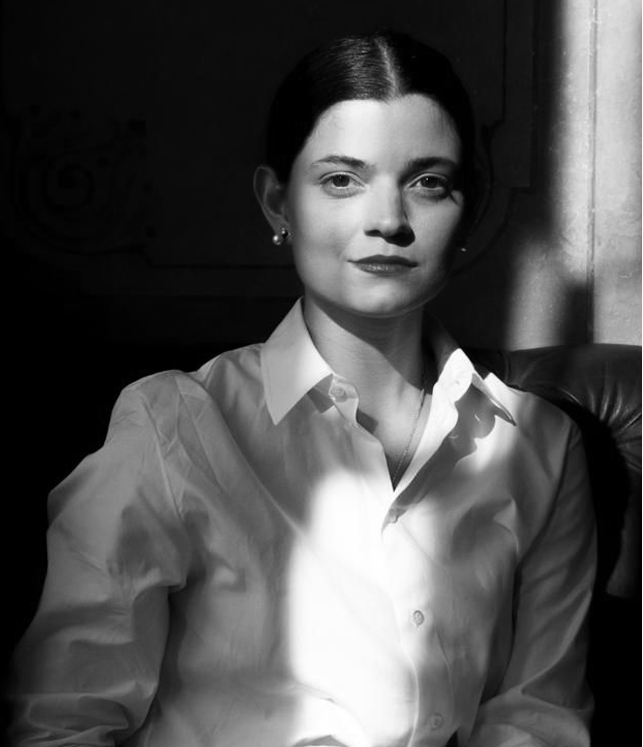
ANA GABRIELA FERNÁNDES
Pianist
“Being authentic in a world that constantly asks us to fit into predefined molds has been a journey of self-discovery and courage. I’ve learned that authenticity isn’t just about staying true to who I am as an artist but also about embracing my imperfections, contradictions, and unique rhythms.”

About ANA GABRIELA FERNÁNDES
There are stories that transcend the ordinary, carrying with them the weight of authenticity and the spark of genius. Ana Gabriela Fernández is one such story—a concert pianist whose music speaks to the essence of what it means to be human. From her earliest days, her hands found in the piano not just an instrument, but a world of infinite possibilities. What began as the dream of a young girl has flourished into a reality that extends beyond stages and borders. Ana Gabriela has not only realized her dream of becoming a renowned pianist but has also turned her music into a universal language, a bridge connecting hearts and illuminating the unspoken.
Her journey started at the National Autonomous University of Mexico (UNAM), where her talent was honored with numerous distinctions, and continued with her training at the illustrious conservatories of Prague and Amsterdam. Yet, Ana Gabriela’s story is not merely one of technical mastery; it is one of emotional depth. With each performance, she offers more than sound—she offers a piece of her soul. She transforms notes into stories, carrying audiences through the intricate landscapes of human emotion.
Ana Gabriela is not just a pianist; she is a storyteller, a healer, and a visionary. In her music lies the ability to transport, to soothe, and to inspire. Through every performance, she creates a shared space where the barriers of language, culture, and experience dissolve, leaving only the profound connection of one soul to another.
In Beauty Voices, we celebrate Ana Gabriela Fernández not only as a virtuoso of her craft but as a pioneer of authenticity and vulnerability. She reminds us that the most profound art comes from the courage to be fully oneself. Her melodies are a testament to the boundless capacity of the human spirit—a reminder that beauty is not just seen or heard, but deeply felt.
Authentic beauty is not something we show; it’s something we live. How do you find beauty in the small moments of your daily life, and how does that experience translate into what you share through your music?
Authentic beauty, as you rightly mentioned, is not something we show but something we live. In my case, I find beauty in the simplicity of small, everyday moments: in the sound of rain tapping against the window, in the stillness of the morning, in honest conversations, in the natural rhythm of life around us. Each of these moments carries a subtle, almost imperceptible harmony, yet one that is deeply meaningful.
For me, music is the way to capture and convey that beauty. Through the notes, the nuances, and the silences, I try to reflect those experiences and emotions that arise from the ordinary. When interpreting a piece, I don’t just follow the sheet music—I strive to infuse it with that personal touch that comes from having lived and felt the moment. Music becomes my language to share what cannot be expressed in words, and I believe that true beauty lies in the sincerity of the interpretation, both for the one who listens and the one who plays.
We are not always defined by what we do, but by what we leave in others. What message do you hope your music conveys to people beyond virtuosity, and how do you want it to transform them?
I firmly believe that music, beyond technical skill, has the power to touch the deepest fibers of the human soul. My hope is that what my music conveys is something genuine, something that goes beyond ability or technical perfection: I want those who listen to me to connect with their own emotions, reflections, and memories. Music has this unique ability to open doors to who we are, to make us feel and think in ways we might not even imagine.
What I would most like my music to leave in others is a sense of calm, comfort, or hope. A moment of introspection, or perhaps transformation, where the music allows them to see the world from a different perspective. In my interpretation, I strive to share a vulnerability, an emotional sincerity that transcends technical execution. If my music can in some way touch people’s hearts, make them feel less alone, or more connected to their own inner world, then I feel my purpose is fulfilled. In the end, what I hope remains is a sense of having experienced something authentic—something that inspires them to move forward with greater clarity or emotional openness.
Society often measures success by external metrics, but real impact goes beyond numbers. How would you redefine success from your perspective, and how do you encourage others to find value in what truly matters?
From my perspective, success is not measured by external metrics such as the number of concerts, awards, or public recognition. While those aspects can be gratifying, true success lies in the authenticity of what we do and in our ability to touch and transform others through who we are and what we create. It’s an internal success—the kind that comes from living in alignment with oneself, from being able to look back and feel that we gave our best, that we shared something genuine and meaningful.
True success is also found in the ability to learn, grow, and experience each moment with humility and openness. For me, the real impact of music—or any other form of expression—is its capacity to make others feel something profound, something that connects them to their humanity, that speaks directly to their heart. That’s where true value lies.
In a world that often demands perfection, showing our vulnerability is an act of resistance. What has been a moment when you decided to share your truth, and how did that courage change the way you connect with those who listen to you?
I would invite others to find their own definition of success, to step away from external pressures, and focus on what truly moves them: passion, creativity, and connection with others. Success can simply be the act of staying true to oneself, of leaving a positive mark—no matter how small—on those around us. That mark is what truly matters, beyond numbers or visible achievements.
In my journey as a pianist, I’ve learned that true connection with an audience doesn’t happen when we aim for technical perfection but when we show our vulnerability—when we are honest with ourselves and those who listen to us. I recall a particularly revealing moment when I decided to share my truth through a freer and more emotional interpretation. I was performing a piece that had always deeply moved me but that I used to approach very controlled and technically, out of fear of not “doing it right.” During one concert, I let go of that pressure for perfection and allowed myself to feel every note, every silence, without worrying about what was expected of me.
It was an act of courage because I risked falling short of expectations, but it also allowed me to be genuine, and that completely transformed the way I connected with my audience. I could sense that the people were not just listening to the notes but were experiencing the emotion of the piece alongside me. The music ceased to be merely a technical execution and became a vehicle for profound communication. That vulnerability enabled me to go beyond surface-level perfection and touch something more human, something that resonated with the audience’s experiences and emotions.
From that moment, I understood that the true beauty of music—or any form of artistic expression—lies in our ability to be honest and vulnerable. When we share our truth, we not only allow ourselves to be who we are but also invite others to do the same. It is in that authenticity that the magic and the connection truly exist.
Music has the power to heal and deeply connect with human emotions. What role has music played in your own personal healing, and how do you use your art to offer that same space to others?
Music has played a fundamental role in my personal healing process, serving as a refuge and an emotional language when words fall short. Throughout my life, I’ve experienced moments of uncertainty, sadness, as well as joy and gratitude, and in each of those moments, music has been a way to process what I was feeling. When I couldn’t find solace in anything else, the piano was always there, offering me an outlet to express what I couldn’t otherwise articulate. Music has this unique ability to embrace our deepest emotions while simultaneously providing a space for release and clarity. On my journey, I’ve learned to listen to myself and heal through melodies, silences, and shifts in dynamics.
As I deepened my artistry, I realized that my responsibility as a performer goes beyond simply conveying a piece of music—it’s about offering that same space of healing to others. Every time I step on stage or share my music with an audience, I aim to create an environment where people can leave their worries behind, let go of daily tensions, and immerse themselves in a moment of introspection and peace. My goal isn’t just to display virtuosity; it’s to make music a channel for emotional connection. If I can provide others with the same refuge and release that music has given me, I feel I’m fulfilling my deepest purpose as an artist.
Music is a bridge between emotions between human beings. I like to think that when I interpret a piece, I’m inviting people on an internal journey, to a space where they can find comfort, awareness, or even a spark of hope. Each performance is an opportunity to heal, to share, to feel, and to connect.
Today, authenticity is one of the most transformative forces. How have you learned to be authentic in a world that constantly tries to put us into boxes, and how do you use that authenticity to inspire those who follow your work?
Being authentic in a world that constantly asks us to fit into predefined molds has been a journey of self-discovery and courage. Over the years, I’ve learned that authenticity isn’t just about staying true to who I am as an artist but also about embracing my imperfections, contradictions, and unique rhythms. In such a competitive and expectation-driven environment, the pressure to conform to certain standards can be immense, but I’ve come to realize that true strength lies in being honest with myself and my art.
Music, as such a personal and emotional language, has been my gateway to authenticity. I’ve learned to trust my intuition, to follow what I deeply feel in the moment of interpretation, rather than strictly adhering to what’s expected of me from a technical or conventional perspective. This freedom to be genuine in every performance has not only allowed me to grow as a musician but also as a person.
What drives me to share this authenticity with others is the desire to inspire them to do the same. I firmly believe that each person has a unique voice to offer, a voice that cannot be imitated or forced. By showing my vulnerability and sharing my truth through music, I invite those who listen to me to connect with their own being and break free from external expectations. In my experience, authenticity is not only transformative for oneself but also has the power to inspire others to embrace their own paths without fear of being who they truly are.
My music becomes an extension of this pursuit of authenticity—a space where there are no masks or pretenses, only the truth expressed through sound. In the end, what truly matters is not fitting in but being faithful to our own essence. Through that honesty, I hope to inspire others to do the same.
True legacy is not measured in awards or accolades but in the lives we touch. If you could choose one idea for future generations to remember about you and your art, what would it be and why?
If I could choose one idea for future generations to remember about me and my art, it would be this: music is a universal language that, beyond notes and technique, has the power to deeply connect with who we are as human beings. My greatest wish is that my legacy is not measured by the number of awards or achievements I’ve accumulated but by my music’s ability to touch the emotions and lives of those who hear it.
I have learned that the true power of music does not lie in its technical perfection but in its ability to communicate what words cannot: pain, hope, joy, and vulnerability. If there’s one thing I want to leave for future generations, it’s the idea that art, in its most authentic form, can be a source of healing, a refuge in difficult times, and a way to create genuine connections between people, regardless of their background or circumstances.
I want my music to be remembered as a space where human emotions and experiences meet and transform—a reminder that amidst the complexity of life, we can always find beauty in the simplest and most profound parts of our being. In the end, that’s the true legacy: having touched, in an honest and direct way, the souls of others.